Michael Clarke
As I write this the leading story on mbl.is is the proposition to build a second road tunnel under Hvalfjörður.
Having been here only a few days in 1971 I asked my host if there was a chance he could take me on a short road trip. He said that he needed some parts for his Vanguard from a garage in Dalvík so we set off along the coast road. The “road” actually disappeared at the edge of the town and turned into a dirt track and as the old English car rattled its way over the humps and bumps I soon realised why it needed the parts.
In these days a trip to Reykjavík was a 12-hour nightmare. The narrow roads twisted and turned around just about every obstacle that could be found on the way. Every rocky outcrop was considered sacred and the dirt tracks weaved in and out so as not to disturb the ELVES! Everyone drove too fast causing the loose gravel to form pretty wavy patterns, particularly going up hills. These were called washboards, and the trick was to find the exact speed to surf over them so that the shock absorbers avoided your wheels following the contours of every wave like a needle on a buckled record. If you went too slow you shook up and down like a cart with square wheels. If you went too fast you lost control ended up in a ditch. If you had a big American car you sailed over it like a liner on choppy seas.
There were numerous single-track bridges en route. If you were lucky enough to see them you put you foot down hoping to get there first. If it were foggy or a blizzard more often than not you would have to reverse back from the middle, presuming that you could come to an agreement with the other car as to who had got there first. My mother-in-law had been one of the first women in the country to get a driving licence, and once had to reverse over two bridges in a row, not because she had come in second, but because she was a woman! The bridges were built perpendicular to the roads to save money, so immediately in front of them was a ninety degree turn, strategically placed to make it easier to skid on the loose gravel out into the river.
Cars threw up dust trails like cowboys across the Arizona Desert, and the yellow dust seeped through every orifice in the dashboard and into every orifice of your body. For such a journey you needed at least two boxes of tissues and three replacement air filters. Everything that could rattle did, and eventually fell off.
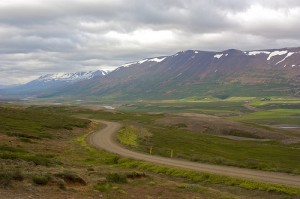 Everyone drove in the middle of the narrow roads, which left a wheel-high spine of loose gravel in the middle. The greatest perils were so-called blind hills. You kept to the middle of the road until the very last minute ready to lurch to the right should you be so unlucky to meet a car at the top. If you managed to make it without loosing control you would find yourself out in the grit on the soft edge. The cars would meet with a whoosh of stones and rubble and dust, and when it had settled you quickly checked to see if you still had doors, wing mirrors, windscreen, and were still on the road, before proceeding to the next Close Encounter.
The last part of the journey was Hvalfjörður. Just when you thought you had nearly completed the tortuous hell-ride and the spire of Hallgrims church in Reykjavik loomed tantalisingly close, you remembered the twisty fjords ahead; a perilous hour- long roller coaster ride. And the frustrating thing was that the end of the road was clearly visible just across the water, like a mirage in the Sahara, but just out of reach.
The Hvalfjörður tunnel was a miracle and knocked nearly an hour of frustrating dusty vibration and blind hills off the journey. Always planned as a toll road, they expected about half the road users to choose the tunnel. In point of fact just about everybody does, and feel 600 kronur is a small price to pay. So now there is so much traffic that they are considering building a second tunnel.
The road from Akureyri to Reykjavik is now tarmac all the way. The single bridges have all gone, as have most of the switchbacks and bends. But every now and then the road repairing mob come out in force. Tar is painted on long stretches and then tons of loose gravel are heaped on the roads, and left there for weeks! They say it is done to let it sink into the surface. But I think it is done to remind drivers of How Things Were in the Old Days. The scrunch of the gravel, the jiggering on the washboards and the dust in your nostrils are back just for a nostalgic few kilometres! Ah, those were the days!
Michael Clarek